Let’s get ready to roll!

The next steps in this build were to install the throttle, PAS (pedal assist system), motor controller, battery and motor wiring.

I had done my research and determined that I would need a 1500w motor and controller to get speeds of 35-40mph with a a 48v battery. I also knew that I would not be able to afford the batteries quite yet for this build, so to start I would be using a 36v battery that I had for my other ebike. I chose to use a 45a controller that was good for 36-52v to power my motor. I wanted to oversize the controller so that it would run cooler and give me the option to upgrade power in the future. The controller I chose also had desired features such as regenerative abs, lighting control, and a color display.

I knew I wanted to mount the controller underneath the seat of my moped to give it a nice clean look. This also allowed me to run all of the wiring to one central spot on the moped. I also wanted to keep it and all of the wiring protected so I decided to put it in a good weather-proof bag.

Controller Bag

I made use of the moped’s tool box as another junction box for wiring.

Tool Box
Controller Bag Mounted Under Seat

For the throttle, I wanted to have a full twist throttle like the original moped. The kit that I ordered came with a half twist throttle that needed to be modified to make it a full twist. I ordered handlebar grips I wanted, cut the throttle side, and epoxied the grip to the throttle body. This gave me a nice custom throttle.

Handlebar Grip
Throttle

I ordered a PAS that would work on the right side of the moped crank. I attached the sensor to the old motor mount under the frame with a bracket that I made. There was also the perfect amount of room between the pedal crank and the frame for the magnet plate! Now I had the flexibility to either pedal the moped with the help of the motor and/or use the throttle.

PAS Sensor

The kit also came with a color display. The display is used for programming the controller and displaying information.

Display

I programmed the controller settings according to the motor, wheel size and battery being used.

Program Settings
Advanced Settings

The only settings that I didn’t use as recommended was the P5 “power monitoring“ setting and c5 “maximum current” setting. I was planning on eventually installing a 52v battery, but for the meantime I had a 36v battery available to use that was only rated for 25a continuous current. I did some research and found that people had the best luck with setting p5 at 15 for 36v, 20 for 48v, and 26 for 52v. I also adjusted c5 down to a 22.5a limit to keep the bms on the battery from tripping.

For the battery, I really didn’t have enough room in the controller bag for it to fit. I decided to order a pair of custom saddlebags (originally for a Harley Sportster) and modify them to fit on my moped. I was able to use one of the saddlebags to store the battery with the other for another battery and/or additional storage!

36v 14ah battery with 25a bms
Saddlebag
Left Saddlebag Installation
Right Saddlebag Installation
Controller, Seat and Battery Installed

Lighting and horn

For the lighting and horn system I wanted to keep it pretty simple with a headlight, tail light, brake light, front and rear turn signals and a horn. I also wanted to be able to control everything with handle bar switches. The following is a schematic of how I wanted to lay everything out:

Early Wiring Schematic

I went ahead and added a 60v to 12v 10a step-down DC converter, to be able to run regular LEDs for my lighting and a 12v horn. I wanted everything to be nice and neat so I ended up running all of my wires for the front lights using the old tachometer as a junction box.

Old Tachometer With Internals Removed
Speedometer Cover
Front Turn Signal
Turn Signal Flasher Relay
Horn
Headlight
Right Switch

For the right switch, the ON/OFF controls power to both the Headlight and Tail light. The bottom button is the right horn button.

Left Switch

For the left switch, the HI/LO is the Headlight/Daytime Running Light (DRL). The middle 3-way ON/OFF/ON switch is the left and right blinker. The bottom button is the left horn button.

Rear Light With Turn Signals

Next up was to tackle the brake light system. This part was a little tricky because I wanted the brake light to be triggered when either of the brake levers were depressed. There are a couple of ways to do this, the easiest is if your motor controller has a brake light output wire. However the controller that I was planning on purchasing did not. I once again scoured the internet looking for options and stumbled upon a great post on Endless Sphere forums that had exactly what I was looking for: https://endless-sphere.com/forums/viewtopic.php?f=2&t=75171&sid=2c7e5bfdad2e249c423274b408d7ed10&start=25 The post uses an octocoupler relay to trigger the brake lights.

Brake Relay Wiring

I ordered the relay off of Amazon and tied it into my brake levers. The results were great! I now have a working brake light.

Brake Light

At this point, I had already chose the motor controller I was going to be using. The controller was wired for both a standard battery output for lighting and a switched battery outputt controlled by the LCD screen. I was using the standard battery output to run my 12v system and wanted to make use of the switched output. I decided to tie in some led strips to the switched output for some cool under lighting! The only problem was the out put would be too high for standard LEDs, so I chose to run 4 stands of LEDs in series to drop the voltage down to ~12v per strand.

After the wiring and installation was complete, I was able to test all the lighting using a 42v power supply that I had.

Daytime Running Light
Headlight
Front Right Turn Signal
Front Left Turn Signal
Rear Right Turn Signal
Rear Left Turn Signal
Tail Light/Brake Light
Under Lighting

With all of the lighting and horn functional, the last steps will be to wire the motor controller, the motor, accessories and battery.

Wheels, brakes and motor

Doing an electric conversion on any bike requires the use of an electric motor. There are lots of options when it comes to what motor to use. Do you want hub or mid-drive, front or rear hub, geared or gearless? I knew that I was going to need a pretty powerful motor to get a fairly heavy moped up to 30-40mph. The plan was to get a gearless rear hub motor because; 1. I needed to get a rear wheel regardless (it was missing), 2. Rear hubs give you lots of direct torque for climbing hills and good acceleration, 3. The weight distribution towards the rear of the bike feels more natural to me, and 4. Gearless motors are generally more reliable, quieter and cheaper due to less moving parts.

After weeks of research, I decided on a 1500w gearless direct drive rear hub motor that I found on eBay.

1500w Rear Hub

I wanted to keep the look of the original moped, so I ordered 17” chrome rims for the wheels and 10g stainless spokes to lace with.

17” Rims
10g Spokes

I was able to calculate the spoke length using a handy-dandy spoke length calculator that I found online: https://www.prowheelbuilder.com/spokelengthcalculator. Turns out that I needed 166mm spokes for the front and 140mm spokes for the rear.

After the motor, rims and spokes arrived it was time to lace the wheels. To keep the moped’s original look, I used a two-cross pattern for the spokes. Through some trial and error, I was able to complete the wheels. I will say that the front was definitely much easier to lace than the rear, due to the fact that the motor was quite a bit heavier than the front hub and a little awkward to work with.

After lacing the wheels, I mounted the tires on the rims. This process was fairly easy using the zip tie method. I went with ~40psi in the front and ~50psi in the rear for a smooth fast ride!

Front Wheel
Rear Wheel

My next challenge was the fitment of the rear wheel. The swing arm of my moped had originally had a dropout spacing of 125mm, which was going to be too narrow for the 135mm dropout of the new rear wheel. I used a custom tool that I made in order to spread the swing arm to ~140mm to accommodate the rear wheel. I used some nuts, washers and all-thread from the local hardware store to make the spreader.

Swing Arm Spreader Tool
Swing Arm Post-Spread

Once I got both of the wheels on the moped, I wanted to get the wheels as true as I could. I used a zip tie on either side of the front fork and on either side of the rear shocks, as my fixed points to allow me to true the wheels.

Next up was brakes. For the front brakes I used the original drum brakes that came with the moped. I ordered new brake shoes and installed them.

Front Hub
Brake Shoes
Finished Front Wheel

Now on to the rear brakes. I was forced to use a disc brake in the rear which was going to require a little bit of re-design. I order a rear mechanical caliper and disc from Amazon, that came with the brake cables as well. I also ordered a mounting adapter that I could modify to mount to the moped.

Caliper and Disc
Brake Cables
Mounting Adapter

So after measuring and re-measuring and fitting and re-fitting, I was able to have a functioning rear disc brake!

Rear Brake Installed
Complete Rear Wheel
Right Chain Cover
Left Chain Cover

I learned quite a bit about wheels during this process. In the end, the results turned out great! So with the wheels on, the mechanical portion of the moped build was complete. Next up was to install the 12v lighting/horn.

Moped taking shape

After several weeks of restoration, I was finally ready to start putting things together. At this point I had put together a fairly complete list of parts that were needed to complete the moped. I found most of what I needed from the fine folks over at Treatland, Lucky2strokes, The Moped Junkyard and eBay.

Here’s a picture montage of the complete assembly process.

Seat, Crank/Peddles, Toolbox, Gas Cap and Rear Shocks
Rear Rack and Tail Light
From Fork
Front Fork and Steering Bearings Installed
Headlight and Turn Signals
Front Hub and Bearings
Front Fender and Chrome Tank Pieces
Chrome Trim

After getting this beast partially assembled, next up is the power train and let’s just say the “fun” process of lacing and trueing the wheels!

Prep and paint

My moped still had some of the original blue paint left on it when I got it. I did sorta-like the metallic blue color, but for this project I wanted to go in a different direction. I chose to paint the moped a vintage lime green color that was reminiscent of something you’d have seen in the late 70’s. I chose to use spray paint for the cost and, if done right, the ease of use. I ended up picking a green apple color from rust oleum that turned out to be perfect for what I was going for. I also used a flat black rust oleum for some trim pieces and of course the rest in chrome!

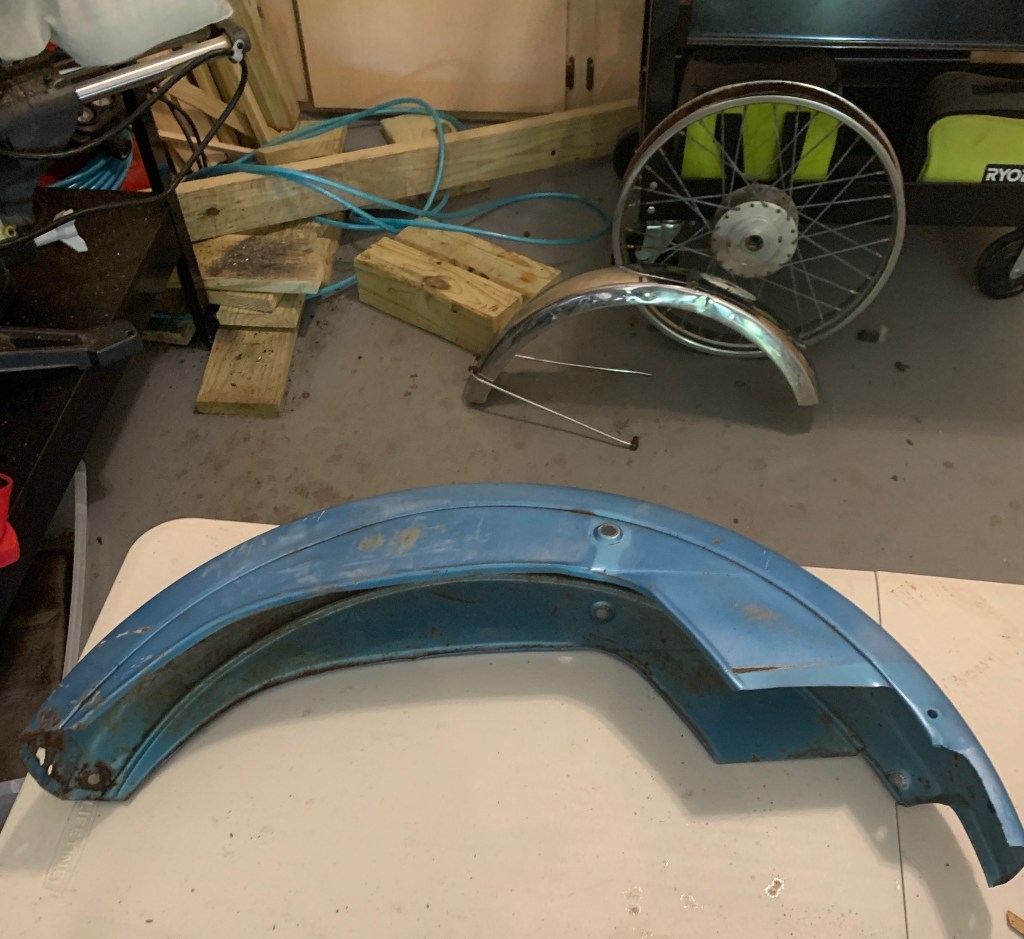
Before the painting could be done, I needed to do some minor dent remediation and prime the pieces that needed paint. I used a ball ping hammer to get the majority of the dents out and finished up with Bondo to smooth everything out.

Rear Fender
Front Fork Covers

Now I will admit that I am definitely no expert when it comes to body work, but through a bit of trial and error and lots of research I feel like I did a decent job!

I rigged a make-shift paint booth inside my garage, carefully making sure that everything was covered in plastic. The plastic definitely helped with dust and kept the paint from getting all over everything (saving me the haste of cleaning and probably saving my marriage as well…).

Now it was time to prime everything. I used rust oleum auto primer spray paint. I also coated the fuel tank with fuel tank sealer to prevent any further corrosion and in case I ever wanted to go back to gas power.

After getting everything primed, I sanded with 600grit sandpaper to smooth and re-cleaned to get all the paint dust off. Now finally time for color!

After color was applied, I wet sanded with 1500grit sandpaper re-cleaned and let the paint cure for a solid week before clear coat. I chose to apply a clear topcoat of polyurethane to finish the parts. I found a great 2k clear coat spray from Amazon that was super easy to use.

2k Clear Coat

So with everything receiving a fresh coat of paint, it was time to start reassembling the frame.

A plethora of rust, grime and old paint

What’s the easiest way to get rid of 40+ years of rust and grime you might ask? Well the answer lies somewhere here! I figured the best place to start was with some degreaser and the car wash. I took all of my various parts up to the car wash with some industrial spray-on degreaser, and it turns out that worked pretty well. The next step was to get rid of the layers of rust and stop any further metal loss. For this, I found that soaking the parts in a tub full of Evaporust overnight then taking a wire wheel to the remainder got the job done

Good Stuff

After all of the soaking, scrubbing and general cleanup we are left with some pretty decent looking parts.

Degreased Parts
Parts With Rust Removed

Now time to get rid of the old blue paint. For this I used paint stripper and a wire wheel. Next on to prep and paint!

Tear down

Ok so first things first, I’ve got a heap of parts that once resembled a moped sitting in my garage. I knew what needed to be done- tear down, document and then make a list of what was missing.

The disassembly process:

Scrap Headlight Bucket, Horn, and Speedo
Handlebar Hardware and Reflectors
Front Wheel, Handlebar and Fender Removed
Rear Fender, Crank, Luggage Rack, Kick Stand and Toolbox Stripped
Front Fork and Seat Pan Off
Little did I know, the stearing tube removal would be let’s just say,”not fun”….

So after purchasing a dremmel tool and some cutting discs, mission accomplished!

Front Fork with Stearing Tube and Shocks Removed
Stearing Tube and Chrome Cover for Front Shock
What was left of the lock nut
Front Shocks

And then there was the swing arm that, for the life of me, I couldn’t remove the bolt from. I ended up cutting the head off the bolt and just sliding it out with the bolt stuck in there forever. Add that to the list of needed parts.

Scrap Swingarm
Front Wheel scrapped as well
Front Axel, Bearings and Brakes
Good Frame. Yay!

I chose not to include the about 1 million rusted bolts that were eventually removed in this process- not wanting to bring back painful memories… just know they were cataloged and replaced with new shiny bolts. See below:

Ok so what do we have now? Answer- a bunch of old rusty/half panted parts, in need of some serious cleaning. Also a more comprehensive list of parts that need to be purchased!

Humble beginnings…

I chose to begin this project for various reasons. I had always thought that owning a vintage moped would be awesome and had not seen anyone attempt to convert a stock moped to all-electric. I was also at a point in my life where I had a little bit of spare time (due to being in between jobs, and you know COVID), so I made the decision to take on this project- for better and sometimes worse!

I began my project by putting a list together of what would be my ideal candidate for a moped: 1. (Maybe most important!) Had to look cool. I was always obsessed with any vehicle from the 1970’s, as my first car was a 71’ Mustang and I knew right away that this would be my era to find a cool moped. 2. Needed to have at least a good frame and easy to find parts. 3. Cheap. (I like to work with a low budget!) 4. Had to have actual pedals!! You’d be surprised at the amount of so-called mopeds are out there that do not have pedals… I mean come on it’s in the name mo-PED.

So I began doing my research on any and all mopeds from the era, and started scouring the usual suspects for candidates(eBay, Facebook, Craigslist, junkyards, etc.). I quickly came to the realization that although quite a few mopeds were produced in the 70’s, however, very few were around today.

Puch
Jawa
Sachs
Motobecane

After searching, for what seemed like eternity, I found something that maybe could work! It fit all of my requirements and was only 30 minutes from my house. However, it was in pretty rough shape…

1979 Motobecane 50v

Ok so it’s a little rusty, and like half of the “stuff” is missing. But after I got the moped into my garage and took a good hard look at what I just bought, I felt like the bones were there and I could have something really unique by putting in the work and saving this classic moped. So I decided this 1979 Motobecane 50v would be the one!